


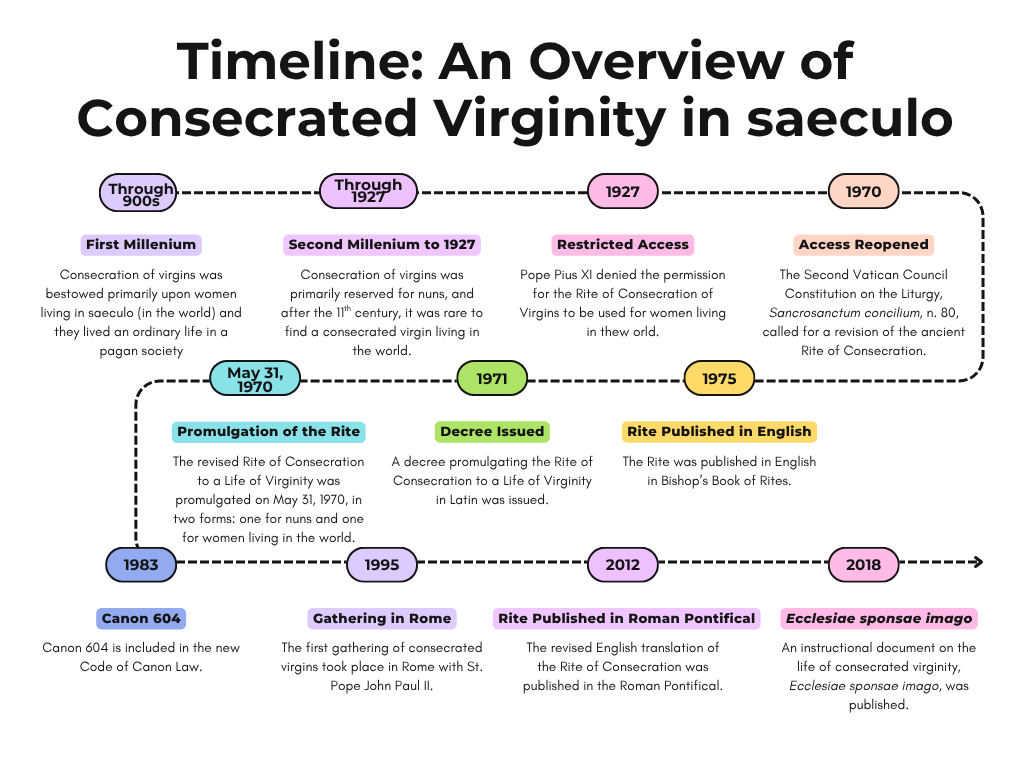
Introduction
When, on August 15, 1868, eight Benedictine nuns received the Consecration of Virgins in the abbatial church of Sainte-Cecile at Solesmes, it marked the beginning of a revived appreciation of this holy sacramental in the Church. Thanks to the initiate of Dom Gueranger, this Rite, which had been neglected for several centuries, started to be revived. Although it never had ceased to be used in monasteries of the oldest Orders in the Church, with the exception of the mendicants, it had never really been widely appreciated for what it is. By November 21, 1958, nearly 100 years later, the apostolic Constitution of Sponsa Christi indirectly encouraged all communities of nuns to take it up again because it was considered "one of the most beautiful monuments of the ancient liturgy."
Although we speak of the Consecration in the Roman Church, or in the Latin Rite, various countries and cultures contributed to its liturgical form according to their temperament and
customs. It is truly the fruit of a collaboration of various Christian countries.
Often one hears that the Vestal Virgins of ancient Rome were the prototypes of the consecrated virgins of Christianity. However, that is a mistaken notion because their resemblance is only exterior, at best. Suffice it to say that the virginity of the Vestals was neither voluntary nor perpetual. The asceticism of the Christians, under its various forms is a means of living out the Gospel, and the holy virgins lived out this evangelical counsel quite early in our history. The Church always cherished virginity, and when, during the early part of the 2nd century, some who were vowed in virginity lived with certain ascetics who would counsel and protect them, the Church put an end to this practice for fear of abuses that could later manifest themselves.
With the 4th century, we see the first evidence of a ceremony of Consecration. However, it is obvious that in preceding centuries consecrated virginity was lived out, but we have no written history of the Consecration until the Church would finally be able to live and prosper in a civil society of peace and acceptance. At first the ceremony was simply Roman in character, but soon the influence of the Gallican (French) Christians penetrated the Rite. By the year 950 A.D., the rite shows influences of the German and it can then be characterized as truly a liturgical hybrid.
Chapter 1: The Christian Virgins before the Peace of the Church
Although the evidence is sparse from the first two centuries of the Church, it is certain that in the heart of the primitive community of Christians a small group of Christians lived a life of total and perpetual continence. In the beginning of the second century, St. Justin cites numerous examples of men and women who kept their chastity all through their life. St. Polycarp (Letter to the Philippians, V, 3) affirms that at the side of the priests were not only deacons and widows, but also a veritable "ordo virginum" within the Church in the mid-second century. In fact, after having spoken about deacons, he addresses himself to the virgins to make recommendations to them: "It is important that virgins live in the purity of a perfect conscience." In later years texts abound with references to virgins who are classified as a group, along with the priests, deacons, and widows. At this time no one term designated these Christian virgins among the writers; sometimes they were referred to as women who have renounced marriage in order to live in continence. In the primitive Church the titles of "sacred virgins," "holy virgins," "spouses of Christ," "handmaids of God" are all used in texts from the first two centuries of Christianity.
We also have no information on the life or occupations of the virgins of this early time. They lived with their family, in all likelihood, and it is probable that nothing distinguished them from other Christians. The Christian virgin who remained a virgin had fulfilled her essential obligation in her state of life. She was neither asked to have a special fervor nor an
extraordinary assiduity in the assembly of the Christians, nor to take on certain good works. Nevertheless, evidence shows that the virgins surely did perform services that were assigned to deaconesses and widows. However, one must be clear to discern that they were not required to perform any particular work or fulfil any defined assignment in the Church. Were they particularly honored in the Christian community? Although no information exists on this point, we suspect that they were so honored and that this situation brought about a temptation to seek favor in the eyes of their Christian contemporaries. St. Ignatius and St. Clement of Rome warn them by reminding them to practice humility in order to combat this temptation to pride.
Finally, we have absolutely no information on how these early virgins embraced their state of life. Did they make a true vow? If so, was it made privately, or before the Christian community when they assembled for worship, or only in the presence of the leaders of the community? What obligations flowed from this profession of virginity? We have no definitive answers to these questions; and the notion of a vow is still vague in the information we have about the Church in these early years.
In the 3rd century we begin to see their life a little more clearly. The documents are replete and furnish us with information relatively detailed about the situation of the virgins. However, just because we have more precise information from documents of the 3rd century does not mean that the virginal way of life did not exist previously. It means only that the contours of that life were not well defined in those first two centuries.
The most prized information we have today from the Church of the 3rd century on the life of virgins comes from the Church in Africa. In addition, from the Church in the East we get the impression that the development of this state of life was not far behind the Church in the West. In Asia Minor and in Carthage we begin to see already a slight tendency on the part of the virgins themselves to separate themselves from the rest of the community.
Although in previous years we have not found a term specially designated to refer to Christian virgins, we see in the 3rd century terms which will be used for them from then on in the succeeding centuries. Tertullian uses the term "holy virgins," a term which does not seem to have been used by any other author of the 3rd century. Caution is advised here, though, because when Tertullian uses this term, he could also be referring to those who maintained chastity until marriage, not necessarily only those who promised perpetual virginity for the sake of Christ. The term "spouse of Christ' at this time, of course, referred to the Church, and this term for the Church would become the current usage in Christian literature. However, the virgins who renounced marriage to become "spouses of Christ" were members of the Church par excellence.
Although Christian writers of this century do not employ the term "spouse of Christ," they certainly imply it when they speak of the Song of Songs (St. Methodius of Olympus) or when
they speak of those who have left their promise of virginity and are called "adulteresses toward Christ" (St. Cyprian). Another expression used by Tertullian expresses the same idea: "virgins married to Christ" ("virgines Christo maritatae"). Although the term "virgin" can express at this time one who has maintained chastity until marriage as well as one who has vowed perpetual continence, in St. Cyprian's writing we find the expressions of "puellae et virgines Christi" and "membra Christo dicata;" these expressions definitely point to virgins who have vowed perpetual continence as opposed to those who maintain chastity until marriage. It must be noted, however, that the terms "holy virgins," "spouses of Christ," "daughters and virgins of Christ," and "dedicated member to Christ" are used only rarely. Tertullian uses "holy virgins," "spouses of Christ," "virgins married to Christ," and "handmaids of Christ" only a handful of times. St. Cyprian calls virgins "daughters and virgins of Christ" and "members dedicated to Christ" only once in his writings. From the few times that these terms are used we cannot draw the conclusion that these same terms prove that virgins pronounced public vows, as some modern authors would conclude.
In the 3rd century, it is clear that the virgins continued to live in their families and participate in the life of the faithful, as they did in the previous centuries. In their daily routine, they lived and worked as other Christians. Nothing distinguished them, especially not a special attire or dress. It is true that Tertullian enjoins the virgins to wear a veil, but this recommendation was given to all young women as they grew out of childhood. St. Cyprian was not concerned about wearing a veil at all, but encouraged them to conform themselves to the customs of their time and place. Of course he urged them to good grooming. They were to maintain their common social relations with all the women, and we see them helping at wedding banquets and even frequenting mixed baths, where men and women encountered each other rather freely. It is true that St. Cyprian did not approve of this latter behavior and reprimanded them quite severely. In Olympus, Methodius encouraged them to avoid public places, wedding dinners, and dances. It is clear that the independence that the virgins enjoyed could lead to real deviations from the precepts of the Gospel. It is no wonder then that the communal life for virgins, which started to take hold at the beginning of the 4th century, was promoted as a way to curb abuses which could result from too much independence and too much mixing with the style of life of the common faithful.
If it be premature to say that the virgins pronounced a true vow of chastity in the preceding period, we would have no hesitation to say that the various authors of the 3rd century leave no doubt that virgins made at least a simple intention or resolution to renounce marriage. It is clear that they made a promise to God to practice perfect continence. How this promise, or vow, was made is still not certain. Did a virgin make it privately? Did she make it before the bishop with the community of the faithful present and according to a definite prescriptive ceremony? According to some interpretations of the authors of the time, the vow of virginity was made in the presence of the bishop and the assembly of the faithful; a certain rite was already in place. Others interpret that the virgin made her promise privately, but the bishop was charged with making known her decision to the community. Others contend that the virgin was consecrated to God in private and that the bishop did not intervene to make the vow public. In the absence of a text making allusion to some sort of ceremony of public profession of virginity, one interpretation today assumes that the virgins made their vow in private and communicated the promise they had made to the ecclesiastical authority; the bishop was charged to make known the vow to the community during a gathering of the faithful for worship. This hypothesis could explain how the virgins could have a private vow and yet be known among the faithful as virgins who were respected and venerated.
In the 4th century, Christian virgins became more and more numerous and began to associate among themselves in community; and, what is more, they entered into their state of life by a liturgical ceremony. They were found in all regions where Christianity had succeeded in implanting itself, like Gaul (France), Spain, Africa, Palestine, Asia Minor, and of course Rome and Milan. They were growing in number in the local churches both of the East and the West., although in the East the rate of growth was slower. Because of the veneration of a bishop like St. Ambrose, some virgins even traveled from their own regions to receive the veil from the hands of this holy bishop. In all the regions where we find consecrated virgins, we find that some started to group together in monasteries, in addition to those living in more personal independence within their families. Some of the bishops, like St. Augustine, favored communal living for the virgins. When the number of virgins multiplied so greatly, it soon became necessary, however, to deal with defections from their state of life. St. Basil in a letter dated in the year 375 denounced those defections from the "Order of Virgins."
Chapter 2: The Christian Virgins in the Roman Church at the Beginning of the 4th Century
Although our information from the first three centuries about the Church in Rome is only relatively precise, we have enough information from the Church in Africa and other Eastern
regions to be assured that in the Church in Rome among the faithful there were persons who renounced marriage in order to respond to the evangelical counsels and who bound themselves to perpetual virginity by a vow. We can be certain that Christian virgins lived in Rome in the early centuries because of the great number of virgins we find in Rome by the 4th century--this fact points to the plausible supposition that virgins were among the numbers of the faithful in earlier centuries. Only after the peace came between the Church and the state do we find documents from Rome to show us in the greatest detail the institution of this state of life in the Church. In fact, Rome furnishes us with the most numerous, most detailed, and most complete history of the liturgical ceremony which accompanied the profession of virginity from the 4th century onwards.
St. Agnes was considered the model of Christian virginity in Rome. Despite her young age of 13 years old when she was martyred (under Diocletian, 304-305), Agnes had already vowed her virginity to God. Documents show other virgins in Rome about this same time--Marcellina, sister of St. Ambrose and who was consecrated by Pope Liberius in 352/353; Asella, of whom St. Jerome speaks and who was consecrated to God about 344; Irene, the sister of Pope Damasus and who was also consecrated about the middle of the 4th century just before she died at age 20; Eustochium; and Sts. Domitilla and Januaria whose names were inscribed in the catacombs as "puella virgo Dei" and "virgo benemerens Ianuaria."
Although the majority of the Roman virgins lived with their families in relative personal independence as in previous centuries, it is very probable that some renounced their
independence to live a communal life. It is known that the first monastery for virgins was founded in Rome in 350 A.D., near the Basilica of St. Agnes. By the time of the invasion of the
Lombards, Rome could count a total of 3,000 virgins in all the monasteries. Pope St. Gregory the Great called them the protectresses of Rome because of the holy lives they lived.
Undoubtedly, various popes, and in particular Pope St. Gregory the Great, favored the communal life over the independent life of the consecrated virgins. However, both forms of life continued throughout the 5th and 6th centuries, just as they had in previous epochs. Virgins who would live either form of life were able to receive the veil (receive the Consecration of Virgins) from the hands of the bishop.
It is necessary to note, however, that not all young women who made a profession of virginity received the Consecration of Virgins. Some made a profession of virginity, but did not receive the Consecration; they continued to live in the world as did those who had received the Consecration. They had made a private vow of virginity, their "propositum," and it was known to the ecclesiastical authority, but it was not confirmed by the ceremony of the Consecration of Virgins. We can see, therefore, that there were two types of virgins: those who were consecrated and those who were not consecrated but content with only the simple "propositum." Those who were consecrated were called "veiled," and those who were not consecrated were called "not veiled."
The popes spoke about the two types of virgins clearly. For example, Pope Innocent I in a letter to the bishop of Rouen, Victricius, says in 404 A.D., that not all virgins are to be treated in the same manner. Those who had been consecrated (received the "veil") should be punished more harshly than those who were not consecrated when they had not been true to their commitment. The pope made it clear that those who had received the Consecration had had their vow officially sanctioned by a liturgical act, whereas the others who were "not veiled" had not. Pope Leo I also had to respond to a bishop, Rusticus of Narbonne, regarding the same question of defection among virgins. Pope Leo I made it clear that there are two categories of virgins: those who had made the vow of virginity (their "propositum") and those who had received the Consecration sometime after they had made their "propositum."
One could be admitted to the category of virgins by simply making the "propositum." However, the Consecration came after a certain time--sometimes during the same liturgical ceremony, but not necessarily. The Consecration rendered the obligations of their state far more serious than the mere "propositum." We know that virgins did wait some time to receive the actual Consecration of Virgins, in the example of a certain Juliana of the 4th century. Her epitaph reads that she had been vowed to Christ for a long time, but as she approached her death, her "propositum" was ratified by the tradition of "the veil," that is, the Consecration.
Chapter 3: The Consecration of Virgins in the Old Roman Rite
The ceremony, or Rite of Consecration of Virgins, at this time had no specially designated term. Various ones existed, with no particular one being finally decided on at this period of history.
However, very early and very quickly in the history of the Church the bishop was required to perform the Consecration, the minimum age of the virgin set, a period of time for probation was required, and eventually the determination of the virgin's free choice was to be determined before being able to receive the Consecration.
From the 4th century on, we see that the Consecration was the exclusive right of the bishop to perform. Even though we do not have any legislative text on this subject before the 4th century, it is clear that all the Consecrations were done by bishops and never by simple priests. In Rome, the pope made it his prerogative to consecrate virgins himself. Throughout the years, from the Council of Carthage in 390, to the synod of Rouen about the year 650, in the Council of Paris of 829, in the Council of Pavia in 850, and on to the Council of Worms in 868--all upheld the exclusive right of the bishop to consecrate virgins, a power not given to a simple priest. In 789 A.D. certain abbesses had to be forbidden, in a most absolute manner, to attempt to consecrate virgins.
The virgin also was under certain requirements before being able to receive the Consecration. Up to the 4th century no age requirement was set; in Rome, as elsewhere, the judgement was left to the bishop who judged each petitioner individually. St. Ambrose and St. Jerome, who were acquainted with Roman customs, did not see a need to set a rule regarding age when they could look to their own experience and societal customs. However, there was a tendency to raise the minimum age for a virgin to be able to receive the Consecration. Some felt it should be the same as the minimum age for deaconesses and widows who were designated to serve the Church--that age was 60 years old. In the 5th century, however, the Council of Chalcedon lowered the minimum age to 40 years old. Naturally, Church leaders feared that the responsibilities given to deaconesses, be they widows or virgins, might be jeopardized if they were given to women who were too young. The same thinking prevailed for the consecrating of a virgin who was too young and without a sufficient experience behind her to guarantee that she would not abuse the privilege of the Consecration. Thus it was decided that the virgin should have proved her maturity in the practice of virtue over the years as well as be of mature age. St. Ambrose had looked to the Roman custom of the marriageable age for women and said that if a woman could be given to a man at that age according to law, why not to God? It is not certain, however, if he meant the simple "propositum" and then would reserve the Consecration itself to a later time in life of the virgin. Nothing shows us any conclusion on the question of the minimum age for the Consecration; however, we do have evidence that the Consecration was given as an exception to
a virgin called Deuteria who was on the point of dying.
We do know, however, that the Church did allow a virgin to make a vow of virginity, the "propositum," at age twelve. This remained intact until the Council of Trent, which raised the
minimum age to 16. The Church in the second half of the 4th century gave in to the rigorist tendency of 40 years old for the minimum age, but later lowered it to 25 years old, where it
finally remained.
For the Church in Rome, we have no documents which deal directly with the subject of age of the virgin in order to be able to receive the Consecration of Virgins. It is interesting to note, however, that Pope St. Leo wrote that the virgin should be 60 years old to receive the "veil." Another text, but not very reliable, states that at the beginning of the 6th century, contemporary custom had it so that a virgin had to be at least 72 years old to receive the Consecration. Some say that these texts had mistakes in them when they were copied into various editions, and that the "sixty" should read "forty" and thus the "72" would be reduced to "52." However that may be, it is clear that the tendency in Rome was that the virgin should be a rather advanced age in order to be eligible for the Consecration.
In other localities, we see a variety of minimum ages. In Spain it was set at 40 years old. Other regions, like Africa, required 25 years old. Provision was made in various regions, however, for the age of 25 in case of necessity or even earlier in case of the danger of death.
Because the Consecration was an official sanction of the vow of virginity, its definitive coronation, the Church wanted to be sure with a measure of certainty that the virgin would live
up to her responsibility. Of course, it is true, that the elevated minimum age eliminated a number of virgins who might otherwise have been consecrated. But it remained necessary,
nevertheless, that the virgin give proof of her seriousness and her firmness of resolution to observe her promise of virginity throughout the time of probation. Much is not historically
certain today about how these early centuries handled the question of minimum age and how to measure certainty that the virgin would live up to her promise of virginity for the rest of her years, but it is known without a doubt that the decision to consecrate was left to the judgment of the bishop. Later, as community life developed, rules were precisely fixed as to the amount of time for probation before the Consecration, at least for those living in a monastery.
Another condition for Consecration was the freedom of the virgin. Civil and canonical law unanimously agreed in the 5th and 6th centuries that a slave could not make a religious
profession without the consent of her master.
The symbolism of the Consecration is fraught with the theme of the Spouse of Christ. The Church was always called the Spouse of Christ, and now the symbolism was transposed to the Christian virgin who had made a perpetual vow of continence. Those who did not keep their vow were considered "Christi adulterae." Pope Siricus sees in the perpetual vow of continence a celestial marriage, and the laws which bind a husband and wife bind the virgin and Christ--unity, fidelity, and indissolubility. They did not believe that this was mere rhetoric, but by these images a reality to be experienced. This is where the symbolism of the veil comes in. In Roman times the veil and a prayer of benediction were inscribed in the marriage liturgy--so also would they be in the celestial marriage of the virgin to Christ. The Consecration took place on great feast days like Christmas, Epiphany, or Easter, (later centuries allowed the Feasts of Sts. Peter and Paul), during the Mass, in the presence of the community of the faithful. The Rite was very simple. First, the bishop reminded the virgin and the faithful of the meaning of the ceremony. It is most probable that the community assembled already knew the virgin and of her resolution to belong to God alone. Following the homily, the bishop recited the prayer of benediction (Consecration) over her and gave her the veil. Very likely the Consecration was performed at the time of the Readings, as is done for Ordination. It is most probable also that after the homily the bishop asked the virgin to renew her vow ("propositum") before the entire community present; she had made this vow in private and had since lived it up to this time. The Consecration itself was effected in the prayer of Consecration properly said over her. In later centuries, we find that the Leonine Pontifical printed the actual prayer of Consecration very likely composed by Pope Leo himself, probably for a Consecration of a Virgin which took place either on Christmas or Epiphany because of the many allusions to the Incarnation.
The veil which she received at the ceremony did not distinguish her in its style from that type of veil of married women. The virgin did not wear any particular type of clothes, either, from this time on; the veil was the only official sign that she belonged to God. Their ordinary clothing was that of their contemporaries of the day, only they were admonished to wear clothes that were modest and colors that were subdued.
Chapter 4: The Elaboration of the Roman Rite
From the 4th century onward, we have seen in Rome and elsewhere, two categories of consecrated virgins--those who lived community life in monasteries and those who lived in the
world, usually remaining with their families. We have no evidence, however, of two categories of the Rite of Consecration of Virgins.
By the 9th and l0th centuries, though, two distinct, well-defined Rites do appear. The majority of those consecrated to God lived in monasteries, but we do see particularly in the Germanic and Frankish countries a certain number of consecrated virgins who were authorized to live an independent life in their families. This isolated type of life for consecrated virgins was not favored any longer by the Church about the beginning of the 9th century; however, it continued on for some time.
About this same time, too, we see the marriage ritual current at that time interposed on the Rite of the Consecration of Virgins. Various symbols in the marriage ceremony were beginning to be used in the Consecration Rite. For example, in the marriage ceremony of ancient Greece and Rome we see a cortege of candle bearers; the tradition of carrying a candle and offering it at the Offertory of the Mass in the marriage ceremony was practiced in the 9th and 10th centuries in northern Europe. In the ceremony of the Consecration of a Virgin we see that the virgin now will hold a candle, as those who are marrying do in their ceremony. However, there is one difference: she is to hold on to the lighted candle rather than placing it among the offerings at the Offertory of the Mass. [It was only Bishop Guillaume Durand who required the virgins to make an offering of it].
In these centuries also, the 9th and 10th, we see more elaboration given to the Rite of the Consecration of Virgins printed directly from the antiphon in the Passion of St. Agnes, not from the Office of the Commons of Virgins. Further elaboration was the prayer "Deus plasmator corporum" which was written in the form of the great prefaces. It asks God to preserve the virgins from all carnal blemishes and to give them a taste for the delights of heaven. The origin of this prayer is intriguing in that it bears the title of "Benedictio Matthaei Apostoli." The ancient authors attribute its authorship to St. Matthew. According to the "Passio Matthaei," the Apostle had evangelized Ethiopia. King Aeglippus (Egyppus) became a Christian, along with all his court. After his death, his successor to the throne, Hyrtacus, asked St. Matthew to intervene in his favor before Iphigenia, daughter of the late king and with whom he was enamored. But, Iphigenia, according to the legend, remained steadfast in her decision to give herself to Christ. She sincerely and determinedly asked St. Matthew to consecrate her to God along with a number of her companions who, like her, had already made a vow of continence. The Apostle did not hesitate to respond to her request: he imposed his hands and recited the prayer of Consecration "Deus plasmator corporum." The author of the "Passion of St. Matthew," who lived at the end of the 6th century, definitely puts in the mouth of the Apostle the prayer of Consecration. In the 10th century we find this prayer of Consecration called the "Benedictio Mattaei Apostoli" in the ritual for the Consecration of the Pontifical of Mayence.
At this time, too, we find new symbols appearing in the Consecration ceremony. These symbols also come from the marriage ritual--the crown and the ring. The ring, a sign of fidelity, is at the same time a pledge of eternal happiness for the faithful virgin. The crowning of those who are marrying was a custom in the Church in Rome, which had come under the influence of Byzantium; it was the Eastern Church which had first integrated the pagan custom of the coronation of the marrying couple into its nuptial liturgy. We do not know exactly, however, when the crowning became part of the ceremony for the Consecration of Virgins, but we do see the melding of the two rites (marriage and Consecration of Virgins) here. When the bishop imposes the crown, he makes an allusion to the mystical marriage of Christ with the virgin.
One last custom in the monasteries, but later dropped completely by the 13th century, was to reserve the Sacred Species consecrated at the Mass during which the Consecration of Virgins took place. It was to be received as Holy Communion by the virgin herself for each of the eight days following her Consecration. The origin of this custom goes back to an old Roman practice which was part of the Ordination rite of priests and bishops.
For those virgins to be consecrated but living in the world, we find at this time, and for the first time, in the pontificals a prayer which the bishop recites and in which he invites all to join with in intention: he prays that God will give the virgin the grace to persevere in virginal innocence so that she might present herself as such to the eternal Judge. For the virgin living in the world, the Consecration ceremony contains a slightly different prayer for the reception of the veil, and neither ring nor crown are given (Rhenish Pontifical). No mention is made either of the reservation of the Sacred Species for reception in succeeding days.
It is clear that during these centuries, the Rite evolved from its ancient Roman sobriety to a form that was very expressive. It took on the form of a true liturgical drama in a age that was experiencing the birth of the religious theater in the West. By taking the text from the "Passio" of St. Agnes, the young Roman martyr who represented the highest ideal of the consecrated virgin, the liturgists of the times were able to set before the faithful a ceremony that showed the "sponsa Christi" par excellence. As St. Agnes had refused the flattery of human suitors and responded only to the invitation of her Divine Spouse, she became a poetic, albeit historic, model for consecrated virgins. All the Oriental display one finds in the Song of Songs was recited in her story. Before the eyes of the faithful, the ceremony of the Consecration of Virgins corresponded truly to a wedding ceremony; the virgin took the place of the bride and the bishop represented Christ, the bridegroom.
Chapter 5: The Roman-French Rite in Rome First Adaptations
In the period from the second half of the 11th century to the end of the 12th, we find that the Rite for the Consecration of Virgins in Rome tried to disengage itself from the influences of northern Europe and elsewhere and reassert itself anew. The Roman temperament did not respond well to the liturgical drama of emotion and imagination that the other cultures of Europe were used to.
Up until this time, also, two forms of the Rite existed: one for those virgins living in the cloister and one for those living in the world. After the 10th century, one can no longer find any virgins living in the world alone. Perhaps there might be one isolated case here or there, but these were extremely rare examples. It was no longer necessary, therefore, to maintain or even produce a special form of the Rite of Consecration for them. If necessary, the Rite for those in the cloister could be used or adapted for a virgin living in the world. In essence, one might say, the two Rites were now combined into one, with the focus on consecrated virgins living in monasteries.
Chapter 6: The Work of the Curia in the 13th Century
In the early years of the 13th century, the Curia tried to work on an official pontifical. It was clear, however, at this time that no matter what forms and variations the Rite of the Consecration had up to this time, one element was always the same: the formula of the Mass.
In the formula for the Rite of Consecration, we see that up until this time, the ring was the symbol of a wedding ring, that is, the Consecration made the virgin the spouse of Christ. The liturgist of the Curia in the 13th century, however, made the ring the symbol of fidelity to the vow of continence. In addition, in times past the crown had been a symbol of the nuptials ("ut uxor eius efficiaris"); now the crown became the symbol of virginity. Lastly, the benediction attributed to St. Matthew was completely dropped from the Rite.
Chapter 7: The Work of Guillaume Durand
Guillaume Durand, Bishop of Mende, restored the idea of the mystical marriage in his work on re-editing the pontifical himself. This was in the late 13th century. He restored the idea of the mystical marriage for the Consecration of Virgins by reinstating some of the symbols that had been dropped. He was not content, however, with the nuptial symbolism only; he brought together also the Consecration of Virgins and the Ordination of the clergy.
As a canonist, he prescribed the days on which the Consecration would be permitted and the necessary conditions according the canons to admit a virgin to the category of those persons consecrated to God. He requested that the consecrating bishop question the virgin, in express terms, on her vow of continence and the sincerity of her act.
Lastly, he summed up and completed a number of rubrics which had been too loosely followed over the years; and he himself followed them exactly. The ceremony, therefore, proceeded
harmoniously because all was prescribed up to the least detail. In all, he remained faithful to the work of his predecessors.
This bishop, Guillaume Durand, first gave the title to the Rite: "De benedictione et consecratione virginum" (The Blessing and Consecration of Virgins). Some liturgists before
him had given one or the other title, "Blessing" or "Consecration," but he used both.
Next, he specified on which days a virgin could be consecrated: Epiphany, Easter week, Ascension, Pentecost, the feasts of the Virgin and the Apostles, and if necessary on all Sundays
of the year except those during Advent and Lent. (A pontifical predating that of Durand also included not only those which he named but also all feasts of the Lord and principal feasts of the martyrs.) The Consecration could also be given on any day in case of danger of death.
He also stipulated that the bishop should make sure that the virgin understands all the conditions stipulated by the law. He should make a minute inquiry the evening before the morning of the ceremony. He should himself inquire of the virgin herself her age to be sure she was at least 25 years old and whether she had understood and freely decided to maintain her virginity. He should question her about her past life and any infractions of her bodily integrity. Although the Rhenish Pontifical and later the Pontifical of Apamee prescribed a questioning of the virgins to be consecrated by the bishop, particularly on the sincerity of their intentions and their understanding of the responsibilities of their holy state, this bishop of Mende rendered more solemnity to this part of the preparation for the ceremony.
He greatly incorporated the parable of the wise and foolish virgins from the Gospel according to St. Matthew: the virgins are waiting for their Spouse. Thus he incorporated the symbolism of candles once again into the Rite. Durand also added something not seen before in the Rite of the Consecration of Virgins: he had the bishop ask the spokesman priest during the ceremony if these virgins were worthy of the honor of Consecration. The priest then was to respond that he believed they were, as much as a human could be assured so. This question and testimony are, without doubt, adapted from the Ordination ceremony. Afterwards, when the bishop addresses the virgins to come forward, he invites them forward three times with the word "Venez" ("Come"). Each time, the virgins advance a little, and then kneel, advance a little, and then kneel. Little by little they advance toward the altar until they finally reach it, and then before the bishop they prostrate themselves on the ground. With each step forward, they recite the antiphons "We follow You without delay and with all our heart; we fear you and we aspire to see Your Face." When they are prostrate before the altar, they chant, "Receive me, Lord, according to Your word, so that no injustice may take hold of me." This part of the ceremony comes from an Ordination ceremony that is quite old because under one form or another we find it already in several pontificals from the 12th and beginning of the 13th century. Also, the triple invitation addressed to the virgins by the bishop comes from a ritual of reconciliation of penitents used by the Pontifical of Apamee for Holy Thursday. He also restored in the Rite the exhortation of the bishop before conferring the Consecration, something that had been in use in early Rome.
At this time also we find the introduction of other religious women who would assist and accompany the virgins to be consecrated. This practice was incorporated from the marriage
ceremony, which used paranymphes to accompany the bride.
Guillaume Durand also required during the ceremony of Consecration an assurance that the virgins themselves stated publicly their promise to be faithful and that they understood the
responsibilities of this sacred state of consecrated virginity. It was at this moment in the ceremony that they offered their hands into those of the bishop and answered his question of "Do you promise that you will keep your virginity forever?" with the words "I do promise." Each virgin then kissed the hand of the bishop and returned to her place. The placing of the hands in those in the bishop again reminds one of the Ordination of a priest when he promises obedience while his hands are joined in those of the bishop. The bishop then kisses the priest. This part of the Rite harks back to the feudal world when the vassal rendered his "homage" to his suzerain. Lastly, we find that the litanies are also in both the Consecration Rite and the Ordination Rite. It is clear that Durand wanted to show the analogy of the two vocations in the Church--that of the priest and that of the consecrated virgin.
Guillaume Durand then prescribed that the bishop bless each insignia given to the virgin-- the veil, the ring, and the crown. In giving the ring, the bishop truly manifested the idea of the mystical marriage. For some years, the thumb, forefinger, and the middle finger were touched with the ring while invoking the Blessed Trinity while touching each finger respectively. The ring finally ended up on the fourth finger on the right hand. Then the formula was simplified to just placing it on the fourth finger of the right hand.
During the Mass not only did the virgins prepare the hosts to be offered, but they also prepared extra for three days following their Consecration so that they could receive Holy Communion from those Hosts consecrated during the Mass of the Consecration of Virgins.
Chapter 8: The Consecration of Virgins according to the Official Editions of the Roman Pontifical
In the Pontifical of 1485, we see a slight modification of Guillaume Durand's ritual--the husband puts the ring directly on the 3rd finger of the spouse in the marriage ceremony and the bishop puts the ring directly on the 3rd finger of the consecrated virgin. In these two ceremonies, we see the two rituals modified at the very same time to keep the correspondences. Also modified was the preparation of the hosts for Holy Communion for three days after the Consecration. This custom was dropped completely. By 1497 the singing of the "Veni Creator" was no longer required after the litanies. Up until the end of the 19th century, because the Consecration of Virgins was so rarely performed, the need to modify the ceremony was not felt at all.
The Consecration of Virgins almost fell out of use completely during the 15th, 16th, 17th, 18th, and early 19th centuries. We see at times, however, that certain bishops tried to revive it and encourage its use. One of these was St. Charles Borromeo for his Archdiocese of Milan. In 1721, on the Feast of the Holy Innocents, the Archbishop of Ravenna, Jerome Crispi,
consecrated thirteen nuns at the convent of St. Andrew. Prosper Lambertini, the future Pope Benedict XIV, noted in 1731 that there were still a few monasteries of Benedictines who at that time would have nuns consecrated. [On July 9, 1959, a group of Carthusians nuns in France received the privilege to have the Consecration of Virgins.--from the thesis of Sister Glenna Raybell] Thanks to the work of Dom Gueranger, interest in the Consecration was revived and the eight Benedictine nuns spoken of in the Introduction received this sacramental on August 15, 1868. The Consecration was considered a privilege of those religious institutes which had solemn vows; those institutes with simple vows, albeit perpetual vows, could not receive the Consecration without an indult from the Holy See. Nevertheless, no general canonical provision made the Consecration the right of only those religious belonging to the ancient Orders of the Church to the exclusion of those religious belonging to congregations or institutes founded in modern times. Theoretically, also, nothing prevented the Consecration for virgins living in the world; no law ever forbade that ancient application of the Consecration. It is known that some bishops did permit virgins to be consecrated who had made a perpetual vow of virginity and who did not belong to any religious institute. [Cardinal de Cabrieres, bishop of Montpellier, between 1917 and 1921, consecrated eight or nine virgins who had made a vow of perpetual virginity and continued to live in the world; Bishop Mermillod, bishop of Geneva, and Cardinal Mercier also
consecrated young women who did not belong to any religious institute.] On March 25, 1927, the Congregation of Religious made it known that the Holy See was not disposed to authorize the consecration of persons living in the world. And, on November 21, 1950, Pope Pius XII decreed that the Rite of Consecration would be an exclusive right of properly called "nuns." At the same time, he encouraged all monastic communities to take advantage of this right, if they had not done so already. It is interesting to note that in the Roman Pontifical in use at that time, even when the Profession of Perpetual Solemn Vows was pronounced, there was inserted after the profession of virginity the question by the bishop as to whether the nun would like to be blessed and consecrated. It is important to note this separation of the Profession of Vows from the Consecration of Virgins itself.
Anne Leflaive, 1899-1987
(taken from Christi Sponsa, 1 January 1996)
Who was Anne Leflaive? For consecrated virgins now benefiting from the restoration of the Rite to virgins living in the world, Anne Leflaive is someone they should revere and treasure. One might even say that God planned that she should be a pioneer of our modern times for the Consecration of Virgins to be restored to laywomen living in the world.
When the Consecration of Virgins was reserved to only a few nuns, like the Carthusians in Europe, Anne Leflaive received it as a virgin living in the world in 1925. She had never been a nun, nor had she ever felt called to Religious Life. How did her Consecration come about?
She came from an educated, industrialist family who owned a metallurgy factory. Well acquainted with the social problems of the day, Anne grew up with awareness of the current world conditions and in a family that was well known to the local bishop who resided in St-Etienne (the town in which her family's factory was located). It was her own great-grandfather who had petitioned the Pope in 1896 for a bishop to reside in the Loire region. Her grandfather obtained one in 1917 in the person of an auxiliary of the Archbishop of Lyon; he would reside in St-Etienne. Bishop Chassagnon, former director of the works in Loire and Vicar General of the Archbishop of Lyon, was named to this post and resided in St-Etienne from 1917-1922, before being promised the episcopacy at Autun. It is understood, therefore, that he was well acquainted with Anne's family.
Little wonder, then, that it was Bishop Chassagnon in 1925, who would consecrate Anne as a consecrated virgin according to the Rite in the Roman Pontifical. This took place at Paray-le- Monial. It was to Bishop de Cabrieres, however, bishop of Montpellier from 1874-1921, that she was most open and whom she regarded as a spiritual father. She considered him as the original instrument of her vocation as a consecrated virgin living in the world.
In 1929 she started to study the Consecration of Virgins extensively; by 1934 she had published a small number of works. After the 1956 encyclical of Pope Pius XII, Holy Virginity, she re-edited her brochure by adding text to it from the encyclical. Her brochure, Epouse du Christ, was honored by a preface written by Cardinal Feltin, Archbishop of Paris. In 1968 she published La femme et l'Eglise; in the pages of the last chapter, she implied an intriguing question, as we look at it today, namely, should the Consecration of Virgins be restored to women living in the world? Fr. Jean Gautier, priest of Paris, gave this work a Nihil Obstat, and E. Berrar, Vicar General of the Archdiocese of Paris, gave it an Imprimatur. Anne's works continued to be published, not only in 1934 and 1956, but also in 1968. She wrote in order to make the Consecration known to others so that someday lay women would be able to receive what she had in 1925. Perhaps it will be possible, when pertinent archives are studied, to know one day if she had been one of those questioned in the 1950s and 1960s by Italian bishops who were weighing the idea of allowing the Consecration to be received by those outside of monasteries.
Anne's life and thinking were profound. Because of her communication with the bishops mentioned above, her experiences during the world wars, and her reflection upon the politics of her country and Europe, she worked out in her own mind and heart some apostolic projects between the years of 1930 and 1945. She conceived the idea of an institute of secular missionaries of Catholic Action. She had spoken of this project to the Apostolic Nuncio, Bishop Maglione; she had asked advice of Armida Barelli, foundress of the Young Catholic Italian Women; she had made contact with a group of Notre Dame du Carmel, whose spirit she loved; and she had reflected a long time with the Archbishop of Cambrai, Bishop Chollet, before writing to Bishop Courbe, the prelate responsible for the whole national plan of Catholic Action in France. (The establishment of such an institute, however, was probably dropped when the Auxiliaries of the Apostolate were founded in 1942 by Bishop Guerry and the parish secular missionaries of Catholic Action were established. It is possible, however, that Anne's ideas inspired Bishop Guerry.)
Anne's ideas, nevertheless, are worth looking at today in order to understand her vision, given that she wrote them in the first half of the 20th century. Her proposal was for young women, without the vows of Religion and who would remain in the world, to give themselves to God in a perpetual promise of virginity. After some seven to ten years of living this life of virginity in the world, they would be able to receive the Consecration of Virgins according to the Rite in the Roman Pontifical. They would always remain truly in the world and set themselves at the disposal of their bishop to aid him effectively in his apostolate. They would have the spirit of participation in the mission of the Church, maintaining and spreading the kingdom of the Father. The consecrated virgin would live particularly a life of humility because this is the foundation of all other virtues. She would work in the spirit of service and mutual fraternity as the primitive Christians. Living in joy like Mary, her model, she would lead the life of a woman of her times in simplicity, humility, and modesty. Like Mary, she would exercise her spiritual motherhood in watchfulness over souls, while waiting for the triumph of the eternal reign of God.
Anne's ideas remain. They remain as exhortations to key virtues that the consecrated virgins in the world should practice, even though the institutes of secular missionaries of Catholic Action were suppressed. The spirit of mission in the Church and support of the bishop are always timely, but especially so today.
Anne remained forever faithful to her vocation as a consecrated virgin living in the world. One thread of the garment of her fidelity comes down to us in her testimony that all her life she was committed to praying the Divine Office; and when that was impossible, she replaced it with the Rosary. She never forgot who she was as a consecrated virgin, nor her bond to Christ, her Bridegroom.
Recent Historical Reflections
In August 1957, at the Liturgical Week conference at the University of Notre Dame, South Bend, Indiana, various participants spoke about the Consecration of Virgins. Their statements, quoted below, are from Liturgical Week (Proceedings) 1957.
Mother Kathryn Sullivan, New York, spoke on the ceremony in the medieval Pontificale Romano-Germanicum:
(It) contains not only one but two ceremonies for the consecration of virgins: the author prepared one for women who wished to live a life dedicated to God in the cloister, another for women who wished to give God special service, living a solitary life in their own homes. . . . Both ceremonies are intimately linked with the Mass. The older tradition was that the consecration be made before the Gospel, just as in the case of candidates of holy orders . . . . The veil and the insignia (ring and crown) were followed by a final blessing. . . . The Mass was continued. . . . (Liturgical Week (Proceedings) 1957, pp. 166-70)
Father Bouman, from Holland, emphasized that in the Middle Ages
. . . the most important rite of the Church was not the taking of vows as such but the blessing by the Church of the virgin. . . . It was considered in the ancient Church as a sacramentum . . . once and for always. (Liturgical Week (Proceedings) 1957, pp. 171-72)
Sister Anne Catherine distinguished the Consecration from religious vows:
The three vows, much later in their origin than the Consecration, are today’s requirement for religious. . . . But it is true that the vows are the creature’s effort to offer himself to his Creator. Beyond that is the mighty consecration ceremony of the Church which is the Creator’s ratification of the offering and the outpouring of His power drawing the virginal soul to Him in sacred espousals. (Liturgical Week (Proceedings) 1957, pp. 172-73)
Msgr. Hellriegel explained the distinction in another way:
There are two kinds of consecration. There is a consecration on our part to God--that is Virgo Deo consecrata. And there is a consecration that comes from God, and that is Virgo a Deo consecrata. One who consecrates herself to God, and the one who by God is consecrated. The first is the silver act to be done in a golden way; the second is the golden act which is everlasting. This is something that cannot be renewed. (Liturgical Week (Proceedings) 1957, pp. 176-78)
- Taken from Rene Metz's The Consecration of Virgins in the Roman Church
This excerpt from the United States Association of Consecrated Virgins (USACV) Information Packet (which is available in its entirety from our online store) is copyrighted and may not be reproduced without express written permission from the USACV.